







Table of Contents
Cemetery of Bilbao, guided tour of the historical and artistic heritage of the Vista Alegre cemetery.
The cemetery of Bilbao or Vista Alegre cemetery, is the first cemetery in the Basque Country to implement a program of guided tours, an itinerary, through which the artistic/historical heritage that we find inside the cemetery is put in value. The self-guided tour is given free of charge with the help of brochures and audio guides, a system implemented in many museums, which effectively leads us through the streets and squares of this peculiar urbanization. The art historian Jesús Muñiz Petralanda, has created a very special tour of the cemetery of Bilbao, an hour-long walk through one of the most outstanding funerary complexes of the peninsula. In it, more than 30 structures are presented, which, with the help of brochures and audio guide, show us some of the most dramatic episodes of Bilbao and Euskadi from a very special point of view.

In the cemetery of Bilbao we find a clear example of the golden age of Basque art, a small sample, with which artists of the stature of the Bilbao sculptor Quintín de la Torre or the architect José María Basterra, show us the artistic/architectural potential of that time. Among the attractions of this space, we must emphasize the pantheons, chapels or mausoleums of some of the most illustrious characters of the town, to emphasize, the Pantheon of Doña Casilda de Iturrizar or the Chapel of the Ybarra Family.
Curious fact: It is estimated that more than 400,000 people have been buried in the Bilbao cemetery throughout history.
It is not the first time that we show you the curiosities of a cemetery, we already did it in our article about the Cemetery of Abaurrea Alta, in the Navarrese Pyrenees, a place that we loved and that we recommend you without any doubt.

Information of the cemetery of Bilbao.
- Type of visit: Self-guided.
- Attractions: Artistic and historical.
- Year of construction: April 27, 1902.
- Telephone: 944 23 10 19
- Architects: Edesio de Garamendi and Enrique de Epalza.
- Area: 208,566 square meters.
- Price: 0€. Free of charge.
- Duration: 1 hour approximately.
- Language of the visit: Basque / Spanish / English.
- Location: Derio and Zamudio, Txorierri Valley, Uribe Region, Bizkaia, Euskadi.
The beauty of the architectural complex surrounding the chapel of the cemetery of Bilbao, is the first surprise that the traveler takes during his visit, but it is not the only one. After visiting the old houses of the chaplain and the undertaker, nowadays archive and offices respectively, we enter a city where the Plaza de la Virgen Begoña is presented as a central space and outstanding core. A unique place that made our hair stand on end.

Cemetery of Bilbao, the hidden city.
For lovers of history and art, a visit to the cemetery of Bilbao is a perfect complement to the rest of the museum spaces offered by the capital of Bizkaia. If you are interested in the curiosities that surround this Basque space, we recommend you to read in detail each of the points that we break down below.

Location: The cemetery is located between the municipalities of Derio and Zamudio, in the Txorierri Valley, about 5 minutes from Loiu airport and less than 15 minutes from the urban center of Bilbao. The proximity to the Bizkaia airfield is another point that surprises everyone who visits the cemetery of Bilbao, because the deafening noise produced by the aircrafts flying over it does not go unnoticed. The land on which the Bilbao cemetery is located was known as Vista Alegre, the name that the cemetery took and with which it is known today. The plot, then owned by the Sociedad del ferrocarril de Bilbao a Lezama, founding company of the line that today is still in operation in front of the current cemetery, was donated to the city of Bilbao with a clear business objective, to significantly increase the number of passengers on the line that linked the Valley of Txorierri with the urban center of Bilbao.

Hours and language: The cemetery of Bilbao is open every day of the year, from 8:00 to 18:00 (in winter) and from 8:00 to 20:00 (in summer). But this is not the timetable that we should take as reference, and is that, to be able to acquire the audio guide and the informative brochures of the cemetery for free, we must access to the offices of the same one, whose schedule is only in the morning. Anyway, if the planning of your trip to Bilbao does not allow you to visit the cemetery in the morning, there is always the possibility of downloading the audio guide and make the visit with the different maps that are scattered throughout the cemetery. We leave you the download of the audio guide and the PDF of the self-guided tour of the cemetery of Bilbao in case you decide for the latter option.
Audioguide: Before starting the tour, we must approach the old chaplain’s house, the current offices of the cemetery. As we enter on the right hand side. It is here, where after leaving our identity document, we are given the audio guide and the informative brochures of the visit to the cemetery of Bilbao. Material, that although it is not necessary to visit the cemetery, it is necessary to know each and every one of the details that surround it. Anyway, as we have indicated previously, you can make the visit by downloading the audio guide directly to your cell phone.

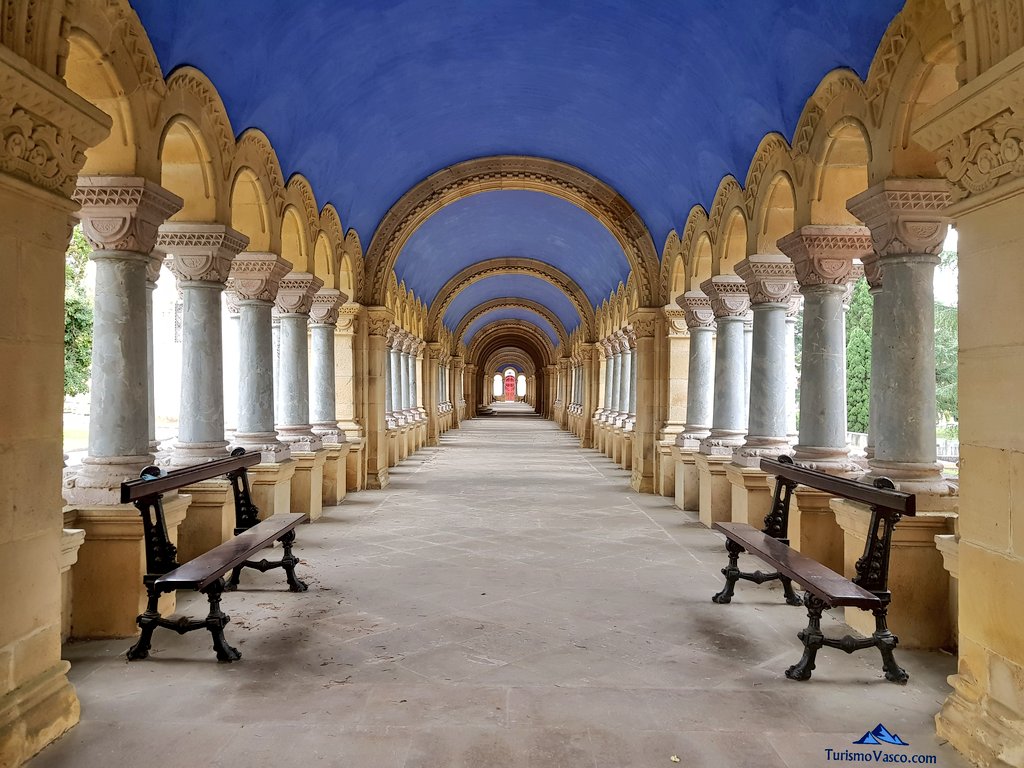
Architectural complex: This space, also known as the “city of the dead”, has an urban organization similar to that of any other urban center. An urbanization, where all kinds of singular structures coexist. The architectural complex of the cemetery of Bilbao has two differentiated spaces. The front part, where we find a large garden area (crypt, chapel, undertaker’s house, chaplain’s house, mortuary and crematorium among others) and the back part, where the area destined for burials is located. The first of these, the garden area, stands out for its two beautiful symmetrical galleries, one of the most photographed areas of the Bilbao cemetery.

History: The cemetery that we glimpse today is not the first cemetery in the town of Bilbao. Prior to this, we find the cemeteries of San Francisco and Mallona, 2 spaces that could not cope with the demand caused by the industrialization of Bizkaia and that gave rise to the construction of the Vista Alegre cemetery. Although most of the people from Bilbao refer to this place as “the cemetery of Bilbao”, it is also known by other names, among them, the “Cemetery of Derio” (the town where it is located) or “Vista Alegre Cemetery” (the name by which the land where it is located today was known).

Although the current cemetery of Bilbao was inaugurated in 1902, the first initiatives for its construction date back to 1887. It was in this year, more specifically on October 6, 1887, when the poor state of the Mallona cemetery, the previous cemetery of Bilbao, caught the attention of the town’s leaders. The disastrous state of the Mallona cemetery, together with the new regulations for the construction of cemeteries, prompted the construction of a cemetery on the outskirts of Bilbao. According to the law passed in 1886, cemeteries had to meet certain requirements: land with certain geological characteristics to prevent seepage into subway watercourses, enough space to house the bodies of the next 20 years (52,000 square meters) or be more than 2 kilometers from any house in the population. After studying numerous locations, it was concluded that no settlement in the town complied with these regulations, which is why, in 1891, it was decided to call a competition to offer locations in other municipalities. Among all the offers made were the lands of the Sociedad del ferrocarril de Bilbao a Lezama, which donated them to the town council for purely business purposes. In 1892, the city council accepted the proposal, but it was not until 1895 when the works began.
Architect: The then architect of Bilbao, Edesio de Garamendi, signed the memory of the project in 1894, but his delicate health did not allow him to finish the project. His successor, Enrique de Epalza, took the reins of the construction of the cemetery of Bilbao, signing some of the new plans and supervising its construction. Therefore, we can conclude that this funerary complex was the work of both architects.

Trees: The cemetery of Bilbao not only has incredible sculptural works, among tombstones, tombs and pantheons, among the more than 200,000 square meters it covers, we find an incredible range of tree species. It has been confirmed that the Bilbao cemetery has 1,479 trees in its interior, among which more than 40 different species have been identified. Among all of them, the following 12 stand out:
- False Banana.
- Acebo.
- Jupiter tree.
- Alligustre
- Himalayan Cedar
- Giant sequoia
- Cypress
- Shuffleboard
- Magnolia
- Common Laurel
- Fresno
- False Acacia.

The most numerous tree species in the cemetery of Bilbao (as in many of the cemeteries of Euskadi) is the Cypress, a tree that can reach a height of 25 meters and is striking for its shape and color.
Why are cypress trees always present in cemeteries? Although the answer to this question is not known for certain, it is said that, in addition to tradition, there are many reasons why the Cypress is always present in the cemeteries around us. Among them, the following stand out:
- Tree of great longevity.
- Tall and leafy, it provides a barrier to wind and other weather elements.
- Evergreen, easy maintenance.
- Vertical root, avoiding problems or breakages in the tombstones or funeral graves.
- Tradition is perhaps the most important reason. In Greek and Roman civilization, these trees were planted near cemeteries.

Living cemeteries: The cemetery of Bilbao is part of the “living cemeteries” initiative. A project of the Association of funeral homes and municipal cemeteries whose sole objective is to raise awareness of the value of the cemeteries around us.

Self-guided tour: The self-guided tour of the cemetery of Bilbao is divided into 40 sections, in 40 numbers of the audio guide. Spaces, which we have visited in first person and of which we tell you our impressions. Although all of them have great value, not all are equally surprising, so we will only comment on those that for us have special value.
- The Crypt: The crypt of the cemetery of Bilbao is one of the first spaces that we find when visiting it. Its location in front of the entrance, at the foot of the chapel, makes it impossible not to notice it. This crypt houses the remains of 321 people who died during different violent episodes in Bilbao.

- The Chapel: After walking along the side of the crypt, we reach the chapel, a small and cozy temple, which is surrounded by 2 galleries inspired by Romanesque architecture that gain prominence at the entrance of the cemetery.

- The Gallery: The beauty of the galleries of the cemetery of Bilbao lies in the paired columns that incorporate the galleries on both sides and the blue color with which they contrast. These galleries offer us shelter in the days of adverse weather.

- Morgue: On both sides of the galleries, there are 2 independent twin buildings, the one on the left side is the morgue, the one on the right side is the Crematorium.
- Firing wall: Next to block 19, we find a fragment of the original wall of the cemetery, next to it, there are the names of 19 people who were shot in this cemetery during the civil war by the supporters of the Republican side. This is not the only wall of firing squad that we find throughout the cemetery, pay attention!

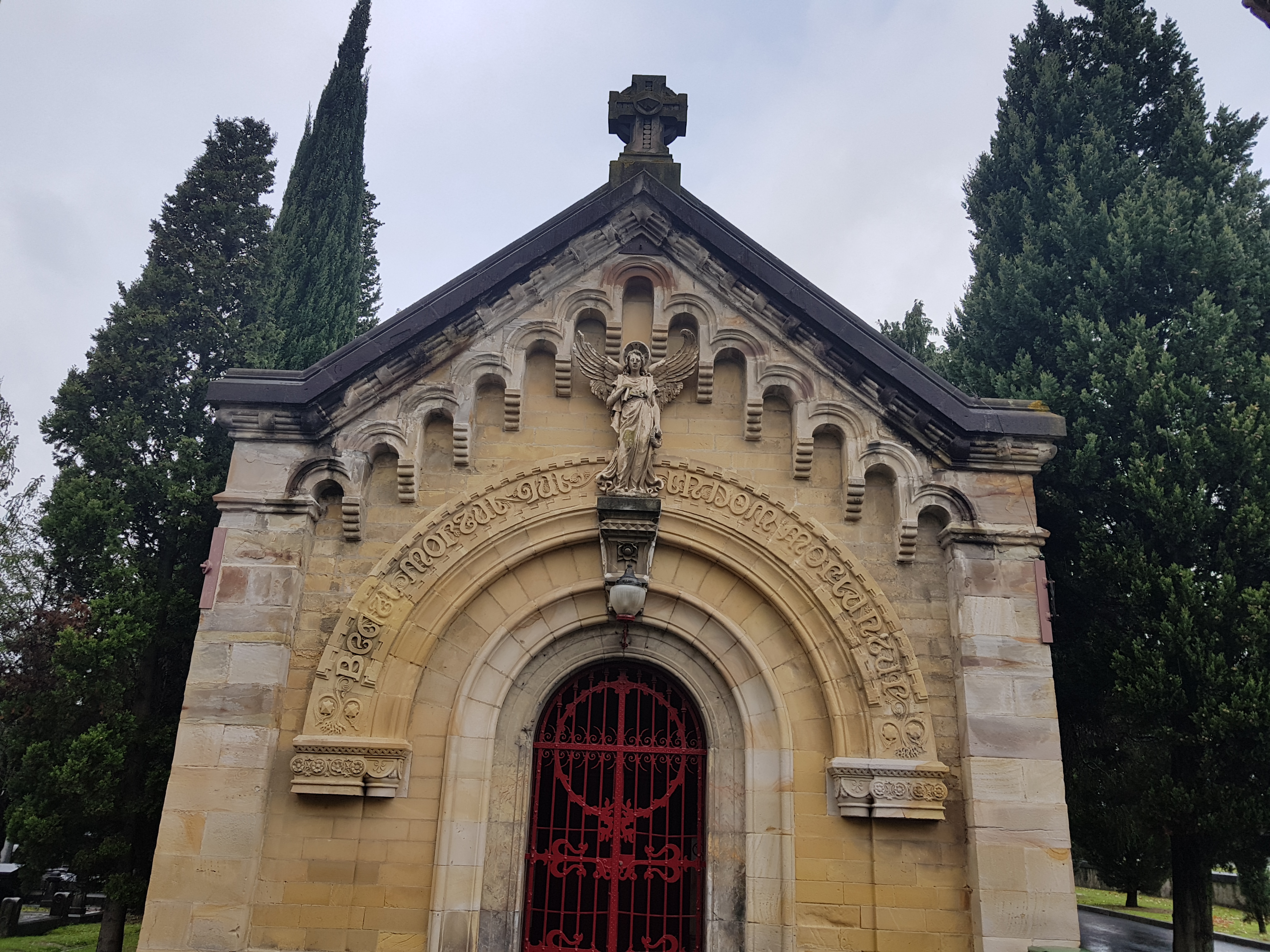
- Plaza de la Virgen de Begoña: In this square are the chapels and pantheons of some of the most powerful families of the old Bilbao. All of them, or most of them, are spaces dedicated to the families that played a fundamental role in the industrialization of Bizkaia. The most representative surnames are those of Ybarra, Chavarri or Olabarri among others.

- Ybarra Chapel: The chapel of one of the most influential families of old Bilbao. It stands out for its large bronze cover finished in a pale green color. Work of the architect Severino de Achucarro in 1904.

- Chávarri Chapel: This chapel is the tallest structure in the entire cemetery of Bilbao. A chapel that although it is not known exactly its creator and date of creation, it is believed that it could be the work of the architect Mario Camiña, around the year 1904.

- Doña Casilda de Iturrizar Pantheon: Although it is a simpler structure than many others we have seen, it belongs to one of the most relevant people in the history of Bilbao. In it rest the remains of Doña Casilda de Iturrizar, widow of Tomás José Epalza Zurbaran (banker and businessman) and one of the most important benefactors of Bilbao during the industrialization. This pantheon is the work of the architect Enrique Epalza in 1905 at the initiative of the Bilbao City Council. Did you know that Doña Casilda de Iturrizar is the only person who gives her name to 2 spaces in the street map of Bilbao? The park of Doña Casilda (the famous park of the ducks) and the street Viuda de Epalza.

- Tapia de fusilamiento: In front of this wall were shot more than 400 militiamen of the Republican side. A plaque with verses by Garcia Lorca and Rafael Alberti honors their memory.

- Monte Oiz: This small corner of the Bilbao cemetery houses the remains of 74 of the victims of the most drastic plane crash in the history of the Basque Country. In it, 148 people died when the Boeing 727 in which they were traveling crashed into one of the slopes of Mount Oiz in 1985 after colliding with one of the antennas located on its summit.

- End of the walk: Here ends the self-guided tour of the cemetery of Bilbao. However, in case you didn’t know enough, we leave you a video (unedited) with the almost complete tour.
Where to eat: Near the cemetery of Bilbao, next to the Zamudio Technology Park and the Bilbao Airport, we found a nice list of restaurants to choose from, but, after tasting many of them, we clearly chose 2 of them:
- Urbasa RestaurantA classic. Basque food. The one of all the life. Unchanged.

- Urbe RestaurantThis restaurant located on the first floor of the Hotel Holiday Inn Express Bilbao, surprises us with a wide gastronomic offer with carefully prepared dishes.

Where to sleep: In the vicinity of the cemetery are located hotels such as the Hotel Seminario or the Holiday Inn Express Hotel, establishments that, although they offer rooms farther away from the city than other hotels, are also somewhat cheaper. It is all a matter of taste. If you want to opt for central hotels in Bilbao, here are two recommendations:


What to see in Bilbao: If you want to know our proposals to know the most outstanding places in Bilbao through a pleasant walk along the estuary of Bilbao, you can not miss our article on what to see in Bilbao in 1, 2 or 3 days.

The cemetery of Bilbao impresses the traveler with the impressive architectural ensemble of its main entrance and traps him with some of the structures surrounding the Plaza de la Virgen Begoña. A visit, to say the least curious in Bilbao.


0 Comments