



Table of Contents
Recreation of the Battle of Vitoria, a historical, international and annual event in the history of Europe.
Every year, the city of Vitoria-Gasteiz dresses up to host the recreation of the Battle of Vitoria, a massive event that makes us travel back in time to 1813. It was in this year, when the capital of Alava witnessed one of the most violent and important chapters of European history, the Battle of Vitoria. Soldiers, women and children, dressed in typical costumes of that time, accompany the horses and cannons that take over the Basque capital for several days to publicize this hard stage of our land. A different and totally free experience that we recommend to all kinds of people.
What is the context of the Battle of Vitoria? This battle is part of the War of Independence. An armed conflict that took place between 1808 and 1814 between the allied countries (Spain, United Kingdom and Portugal) and the First French Empire.

Through the historical and international recreation of the Battle of Vitoria, the battle that led to the defeat and withdrawal of Napoleon’s troops from our territory is put in value. A whole weekend, in which the fields of Armentia welcome more than 300 people coming from different parts of the world to recreate the Battle of Vitoria. Volunteers from Portugal, Catalonia, Donostia, Bilbao, Galicia or Madrid join the international volunteers who make this Napoleonic camp their home. People of different ideologies, ages and sexes, who, for the love of art, offer us a master class in the history of Europe. We must point out that Vitoria-Gasteiz is, since 2013, part of the European Federation of Napoleonic Cities, urban centers, which like the Napoleonic routes (European Cultural Itinerary) are a tourist attraction for lovers of history.

Information on the recreation of the Battle of Vitoria.
- Email: recreadores@batalladevitoria1813.org
- Season: Between May and June.
- Organizers: Provincial Council of Alava, Vitoria Gasteiz City Council and the Association of Historical Recreation Battle of Vitoria 1813.
- Price: 0€, Free.
- Attractions: Recreation of the Battle of Vitoria in 1813 with all kinds of details.
- Location: Campas de Armentia, Vitoria-Gasteiz, Euskadi.
Although the “Asociación de recreación histórica Batalla de Vitoria 1813”, was registered with the Basque Government in April 2014, it has been working since 2013 to investigate, value and promote the historical event we are talking about today, a war of great dimensions, which was decisive in the history of Europe.

Recreation of the Battle of Vitoria, a trip to the past.
Vitoria-Gasteiz has become, thanks to the recreation of the Battle of Vitoria, one of the most important Napoleonic cities of the peninsula, placing it on the map of all those who wish to visit places that are under the brand “Destination Napoleon”, the tourist and historical route that includes most of the cities in which took place some episode related to Napoleon Bonaparte. Many activities are organized on the occasion of this recreation, both in the center of Vitoria-Gasteiz and in the fields of Armentia, where the camp of the troops is established and where later some episode of the battle is recreated.

Curiosities of the Battle of Vitoria.
Upon our arrival, a recreator from Bilbao kindly attended us and gave us all kinds of explanations. During this time, he left us speechless with a series of curiosities that we tell you below.
- Do you know how much does the French “Charleville” musket weigh? 4 kilos.
- Do you know how much the cannons used during the Battle of Vitoria weighed? 500 kilos.
- Do you know how many shots an elite shooter could fire in 1 minute? It could fire more than 2 shots, keep in mind the whole procedure to load the musket.
- Did you know that cavalry carried curved sabers while infantry sabers were straight?
- Did you know that Napoleonic soldiers received 3 identical shoes when they joined the army? One for the left foot, one for the right and one to carry in the backpack. These shoes had the same shape and did not distinguish one foot from the other, so they could alternate them so that they would not wear out and break. They were very uncomfortable and their sole, made of nails, was very slippery on stone floors.
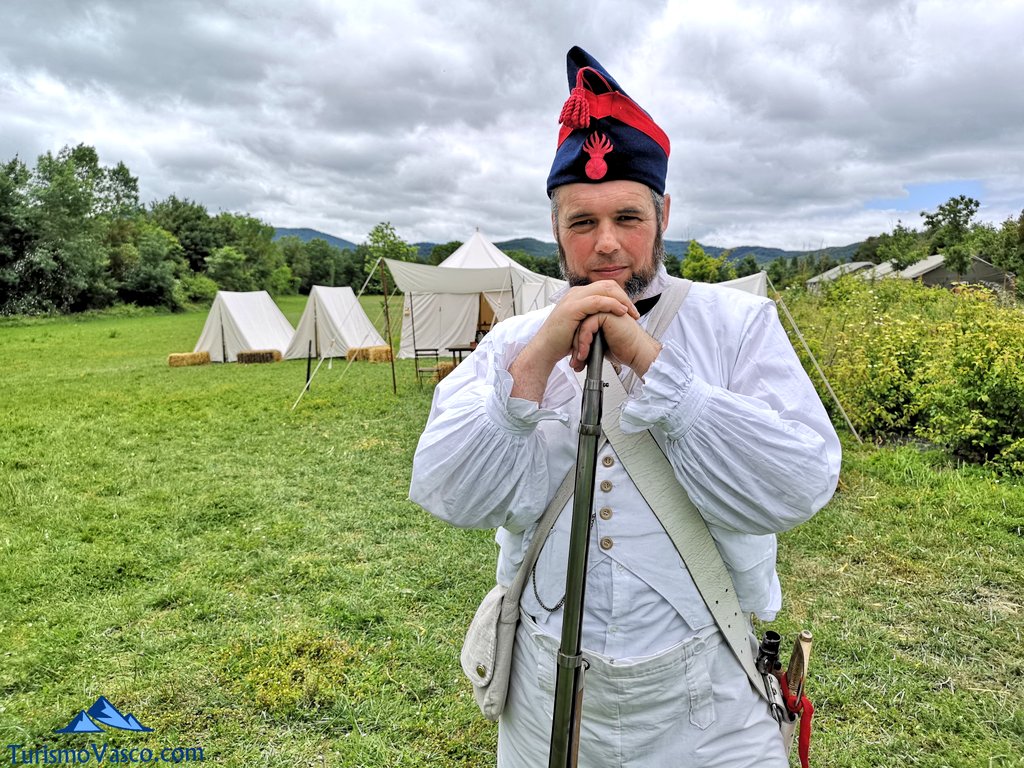
- Did you know that the hat worn by Napoleonic troops goes beyond simple aesthetics? The chaco, also known as chakó or shakó, is one of the most striking hats during the recreation of the Battle of Vitoria. Besides being an essential garment for the soldier’s protection, it was also a kind of backpack where they carried bread and onions. The food of the imperial troops.

- Did you know that among the allied troops were the troops of the Basques Fernández de Leceta, Prudencio Cortázar and E. Salcedo?
- Did you know that the Chanson de l’onion is a French military march that became popular during the Napoleonic era?
- Did you know that on June 21, 1815 Ferdinand VII ordered to award the participants of the Battle of Vitoria with a decoration called IRURAC-BAT, three in one in Basque in reference to the 3 Basque provinces?
- Did you know that today there are several English regiments that bear the name of Vitoria on their flags in recognition of this battle?
- Did you know that several women fought in the battle of Vitoria?
- Did you know that Beethoven composed the so-called Victory of Wellington Symphony, Battle of Vitoria Symphony or Triumph Symphony in honor of this epic episode? As a detail, it was premiered together with his Seventh Symphony on December 8 at the University of Vienna. We leave you a YouTube video where in addition to hearing this piece you can see images related to it.
https://www.youtube.com/watch?v=yz_Q6uzFkl4
What do you think? Curious, isn’t it? If you liked these little historical details, we recommend you to keep reading, we have many more things to tell you about the Battle of Vitoria and the victory of the Duke of Wellington.

History: After the defeat of Napoleon I in Russia, the French imperial troops were forced to leave Madrid on March 17, 1813 with the intention of settling in Valladolid. Faced with this movement of troops, Wellington, who was then in Portugal, began an offensive that forced the Napoleonic troops to retreat towards the Cantabrian coast, towards Euskadi, towards our beloved Alava plain. Thus, the imperial troops settled in the surroundings of the city of Vitoria-Gasteiz on June 19, 1813. The following day, June 20, knowing their destination, Joseph Bonaparte ordered a convoy of about 3,000 vehicles to leave Vitoria-Gasteiz with the booty that the French had obtained during their plundering. Meanwhile, the rest of the troops, camouflaged in different parts of Alava, awaited the arrival of the Allies to confront Wellington’s men. The allies, who outnumbered them in numbers and strategy, pushed Bonaparte’s men towards the city of Vitoria-Gasteiz. It is here, where on June 21, 1813, the great Battle of Vitoria took place. The Duke of Wellington, who had the invaluable help of General Alava, a perfect connoisseur of his land and skilled military strategist, authorized the latter to prevent the city from being exposed to friendly and enemy fire by closing the outer gates. An action that went down in history and for which the city is very grateful today.
 Once defeated, more than 2,000 carriages retreated on their way to Navarre, creating a huge traffic jam. This caravan was attacked from the rear by the allied troops, causing Jose I to flee, leaving behind all the treasures he was carrying. It was a real massacre, more than 1,500 dead and 8,000 wounded. This is how the royal treasure was left in the hands of anyone who wanted to appropriate it, both French and allied soldiers took everything they could, a full-fledged looting. Unfortunately, the towns of Alava were the ones that suffered the most in this battle, suffering looting and great damage in each of the episodes that took place. As for the victory of the allied troops, we can say that it was a turning point in the war, and is that, although the French empire had managed to fight other armies without any problem so far, in Vitoria-Gasteiz, they could not do anything against Wellington’s troops, the French empire was touched and sunk.

Napoleonic Camp: The Napoleonic Camp is, in our humble opinion, one of the most lively and fun spaces of the recreation of the Battle of Vitoria. In it, it is possible to dialogue with the different reenactors to better understand every aspect of this historical event, from clothing and weapons, to the way of life and the way of thinking of that time. As we have said before, it is a trip back in time with all the trappings of the law. In our case, we loved the shooting demonstration, in it, in addition to showing us how a musket works and the care it required, we were shown that it was not 100% effective, as often the spark did not reach the powder causing the shot not to be fired. So we can use the famous phrase “they failed more than a fairground shotgun” to refer to the muskets of that time. Of course, this type of events and talks are not organized, everything is part of the improvisation, so we recommend asking everything that comes to mind, sure that one of the people of the recreation knows how to answer us with total security. We recommend that you mingle among the different groups of soldiers that you find in the camp, surely someone is talking about how much his costume cost, where he bought it, what era it is from, or if he has an interesting project to get a unique piece.

General Alava: Miguel Ricardo de Alava y Esquivel, better known as General Alava, was one of the most important figures of the Battle of Vitoria. Born in Vitoria-Gasteiz in 1722, trained in the Royal Patriotic Seminary of Bergara, he participated in a thousand and one battles before arriving at what would undoubtedly be the most important of his life, that of his homeland, Vitoria. Thanks to his work, Vitoria-Gasteiz was spared from the sacking of the troops fighting in that war, a fact that saved many Basque lives and goods. After this historical event, General Alava held ten political positions and died in Barèges, France, in 1843.

Recreation of the Battle of Vitoria: Once the hour arrives, the regiments leave the camp in formation to go to the battle, to the surroundings of the basilica of Armentia. It is here, where the reenactors get totally into the role to interpret one of the many episodes that happened during the Battle of Vitoria. In this case, they simulated that the stream that we find next to the basilica of Armentia was the Zadorra river, to dramatize the moment in which the allied troops were gaining ground against the troops of the French Empire, who, using all their means, tried to defend themselves with cavalry, infantry and cannons. Although, as everything in life, it depends on the tastes of each one, all the people who were with us agreed that it was a show that brings history closer to the whole family.

“The thunderous sound of the cannons is impressive, and the ones we see here today are much smaller than the ones used at that time”, said one of the commentators of the event. Meanwhile, the little ones of the house covered their ears with their hands and followed with their eyes wide open each of the open fronts in the fields of Armentia.

The end, it was clear, the imperial troops flee in disarray creating a great chaos behind them, while the allied troops take control.

Tips to enjoy the recreation of the Battle of Vitoria.
- Although the recreation of the battle is a great spectacle, we recommend not to miss the Napoleonic camp, the place where the troops can be seen closer and better.
- When looking for the best location to see the recreation, we advise you to be in the vicinity of the basilica, at the top, where you can better appreciate the spectacle.
- Although the crowd that gathers around this spectacle is not very large, we recommend that you go to look for a place before the battle.
- The fields of Armentia are very large, so it is not possible to see with total clarity the movements of troops on the other side of where we are located, taking a pair of spotting scopes or a camera with zoom is not a crazy idea.
- If you have weak ears, we recommend wearing earplugs, as being close to the cannons when shooting is not a good idea.

Monument to the Battle of Vitoria: One of the most important monuments that we find in Vitoria-Gasteiz in relation to the Battle of Vitoria, is the one that we find in the center of the Plaza de la Virgen Blanca, in the center of the city. This work of Gabriel Borras was delivered to Mayor Guillermo Elio y Molinuevo on August 4, 1917, a symbol of suffering and courage, in which the great protagonist of the battle, General Alava, who saved the city from the clutches of war, is evident.

Data of the Battle of Vitoria.
- 57,000 soldiers of the French imperial troops took part in the Battle of, 78,000 in the case of the Allied troops.
- The allied troops were made up of Spanish, Portuguese, British, German, Italian, Polish, Swiss and others.
- The imperial troops were mostly French, German, Spanish and Italian.
- The battle of Vitoria lasted a whole day, from morning to afternoon, covering more than 18 kilometers, almost nothing.
- In 1813, Vitoria-Gasteiz had about 8,000 inhabitants, compared to the more than 100,000 soldiers who moved to Araba, a very significant figure.

Location: Although in most of the occasions the recreation of the Battle of Vitoria is held in Armentia, the fields of Olarizu have also hosted this event in the past. Therefore, we can and must say that the recreation of the Battle of Vitoria does not have a fixed place, but, depending on the circumstances, it is held in one place or another. However, as the Armentia fields are a magnificent setting for this type of event, we blindly believe that the following editions of this reenactment will be held in this same location. A place, in which there are no problems of parking of vehicles, public transport, or space, in short, a perfect place. Anyway, we recommend you to be attentive to our social networks (Twitter, Facebook and Instagram) to confirm the location of the next recreation of the Battle of Vitoria.
Videos: We leave you several videos, all of them of short duration and unedited, in which you can see the true spirit of the recreation of the Battle of Vitoria. If you plan to take advantage of your escape to Vitoria-Gasteiz to visit the rest of Euskadi we recommend that you subscribe to our YouTube channel, sure you will find places that catch your attention.
- Napoleonic camp closed.
- Napoleonic camp open to visitors.
- Cavalry of the Battle of Vitoria.
- Recreation of the Battle of Vitoria.
Where to park: Armentia and Uleta provide us with a good number of free parking lots where we can park, in this sense, the location chosen for this recreation is a real wonder. No problem to park for free.

How to get there: The bus, one of the most used transports in Vitoria Gasteiz together with the streetcar, offers us through its line 4 one of the best options to get to the Basilica of Armentia. This line, coming from Lakua, crosses the center of the city to leave us only a few meters from the main stage of

Where to eat: Vitoria-Gasteiz, like the rest of the Basque provincial capitals, is a great place to enjoy the traditional cuisine of Euskadi. If you want to eat well and at a good price, we recommend you to visit restaurants like “El siete” or “Waska”, we are sure you will not be disappointed.
- El siete: This restaurant has an outstanding menu of the day, but it is not its only specialty, the sandwiches and pintxos of this restaurant in Vitoria-Gasteiz are also a real blessing.
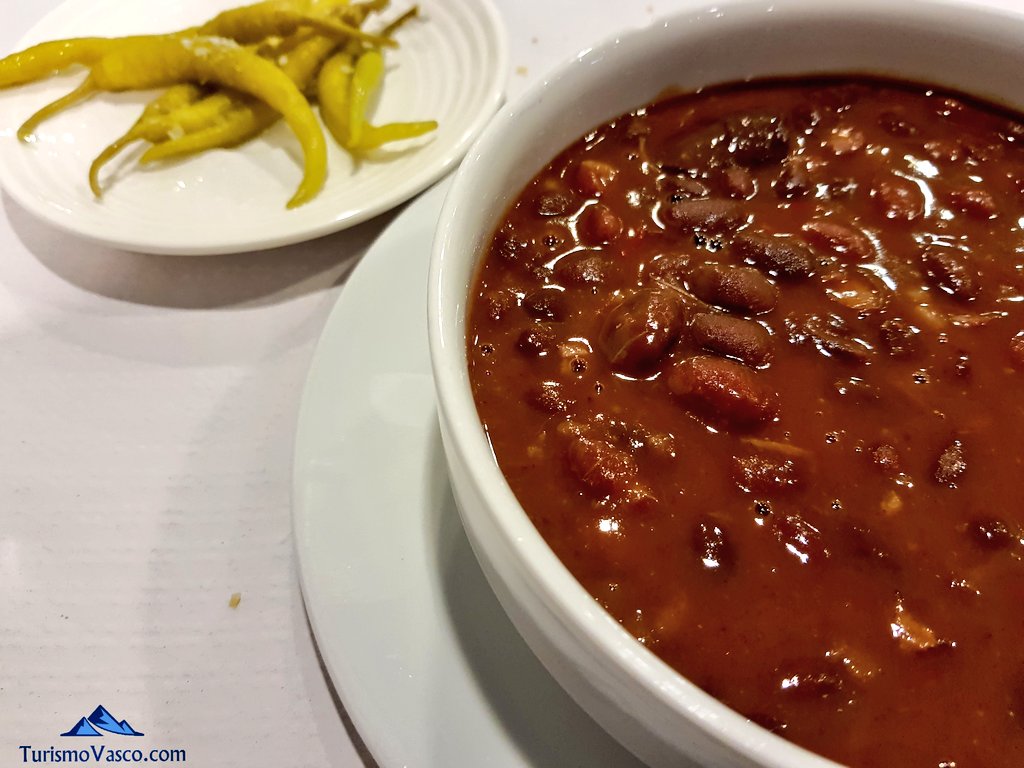
- Waska: Waska restaurant offers a nice mix of modern and classic cuisine. Taking as a base some of the typical dishes of our gastronomy and fusing it with their own creations, they obtain scandalous dishes.

Where to sleep: Very close to Armentia, we find the Hotel Jardines de Uleta, a fantastic 4-star hotel that we highly recommend. Of course, if the price is not convincing, if you are looking for something simpler and cheaper, we recommend the Albergue de la Catedral.


What to see in Vitoria – Gasteiz: Vitoria-Gasteiz is one of the quietest cities with the highest quality of life in the Basque Country, where you can find unusual places such as the Old Cathedral, a great architectural work that we recommend you to visit. We leave you a small list of places to visit during your stay in the capital of Alava:


- Vitoria-Gasteiz Green Belt.

- Plaza de la Virgen Blanca.

- Florida Park.


Consequences of the victory of the allied troops in the Battle of Vitoria.
The Battle of Vitoria is one of the great historical milestones of our territory, and it not only meant the end of the French occupation but also changed the future of Europe. After this battle, Prussia, Russia and Sweden stopped negotiating with Napoleon, turning against him and defeating them in Leipzig.

If you have any questions or suggestions about the recreation of the Battle of Vitoria, do not hesitate to leave us a comment in this article, we will try to answer you as soon as possible.


0 Comments