




One of the must-see places when visiting Donostia-San Sebastian is on the other side of Mount Ulia:
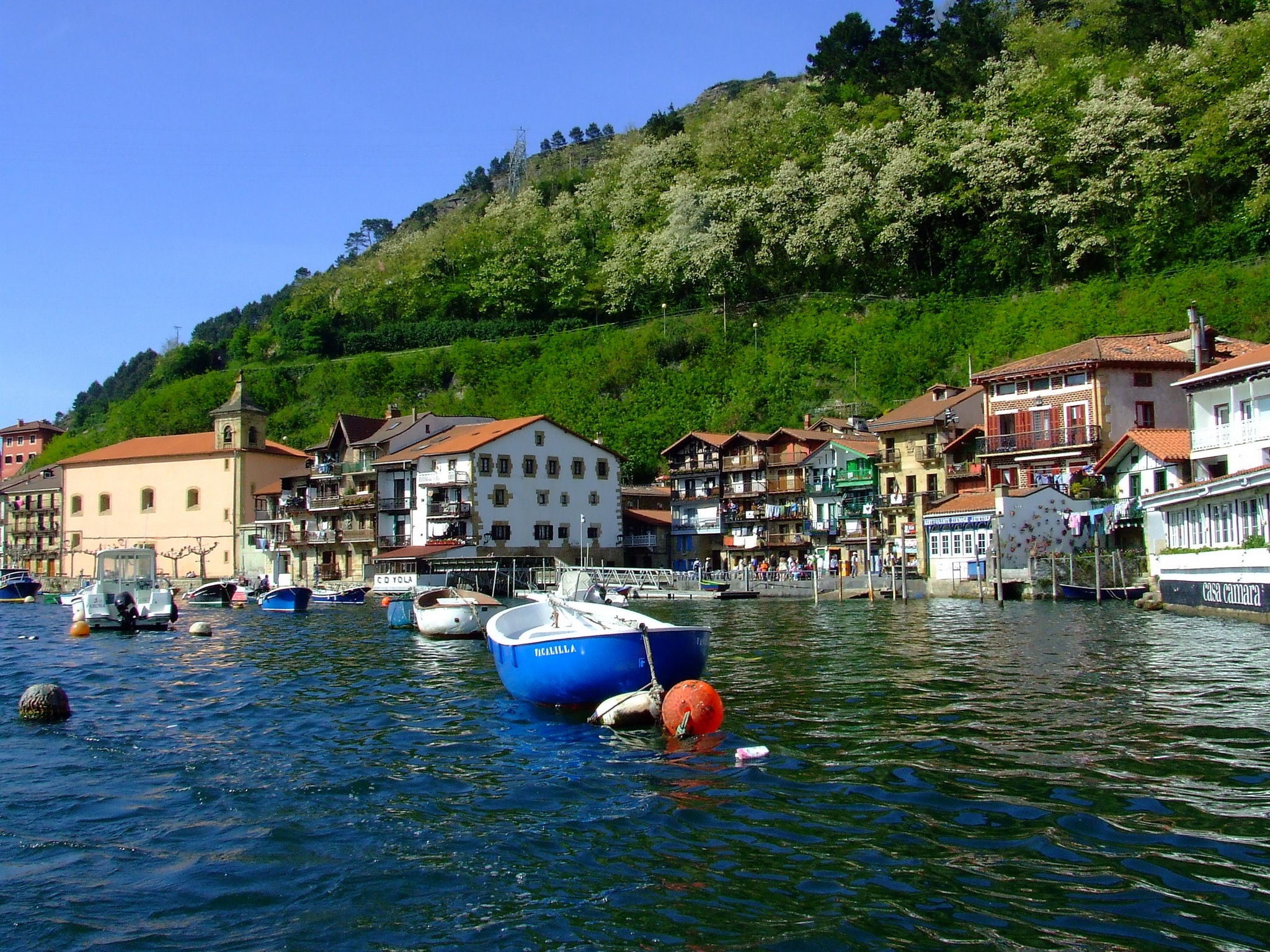
Pasaia. Pasaia is a small fishing village made up of four districts surrounding a bay. Besides being the commercial port of Gipuzkoa, it is considered one of the most picturesque and charming coastal towns along the Basque coast. Victor Hugo himself was captivated by this town, which he called a small resplendent Eden, famous if he were in Italy. Two of its districts, Pasai San Pedro and Pasai Donibane, have two very well preserved historic centers with houses of popular seafaring architecture, arranged in the manner of stilt houses overlooking the sea. Among its historical buildings it is worth mentioning the house where Hugo himself lived, from the XVII century (and museum in his honor since 1902) and the birthplace of Admiral Patapalo, Don Blas de Lezo, from the XVII century. In Pasaia (Pasajes) the maritime culture is breathed by its four districts: in its waters the regattas of trawlers were born and in its numerous restaurants are specialists in the elaboration of the fresh products of the sea that arrive to its port.
We leave you a video about pasaia:
Just a kilometer and a half from the historic center of Pasai Donibane (Pasajes de San Juan) is the University of Lezo, which is the perfect complement for those who visit the former. It is located on the slopes of Mount Jaizkibel, it is an obligatory stop on the coastal Camino de Santiago and is articulated around a small, but very well preserved, cobbled old town. Judging by the number of emblazoned houses, most of them from the XVI and XVII centuries, it can be said that it has a maritime past full of splendor. It is curious to observe how in a historic center of small dimensions coexist, almost attached, two large religious buildings; the parish church of San Juan Bautista, from the fourteenth century, and the basilica of Santo Cristo de Lezo, from the seventeenth century. The reason for the construction of the basilica in that place was the appearance in the 15th century of an unbearded Christ floating in the sea: the one known today as the Santo Cristo de Lezo. It is also one of the main tourist attractions of the municipality for several reasons: mainly because there are very few specimens in the world with these characteristics, and because its appearance is surrounded by a beautiful legend. And not only that, for centuries, so many miracles have been attributed to it that it has become the religious temple with the most offerings and votive offerings in all of Gipuzkoa.
A stone’s throw from Lezo, since it is within walking distance, we find the town of Errenteria. A town with a great industrial past that in recent years has undergone an important urban and sustainable regeneration. Large leisure infrastructures and wide natural spaces surround what is the largest of the medieval historical centers of the whole area. Catalogued as a Historic-Artistic Site of special protection, it has more than 20 elements catalogued as monuments, among which the medieval towers of Torrekua and Morrontxo and the Parish Church of Nuestra Señora de la Asunción stand out, with a very singular iconographic element: the Flemish triptych of the Coronation of the Virgin, in Gothic style. The contemplation of this group of remarkable buildings can be enjoyed at the same time as a wine and pintxos route through the downtown area. Nature lovers should not miss a visit to Lau Haizeta Park and Listorreta-Barrengoloia Park, with several catalogued megalithic stations, Michelin-starred restaurants, marked hiking trails and one of the best viewpoints in Gipuzkoa, the Carlist fort of San Marcos. Good road access, ample recreational areas and numerous hotel establishments make these natural areas the perfect day out for all types of public.
Only four kilometers from Pasaia, and neighboring the previous one, is the town of Oiartzun, which, due to its characteristics, can be the ideal place to stay. It is only a few kilometers from Donostia-San Sebastian and the border with France and very well connected by road and public transport. The hotel and restaurant offer in Oiartzun is unbeatable in terms of quality-price. It is an idyllic place full of meadows, lush vegetation and lots of mountains, ideal if you want to disconnect and rest, but at the same time, very close to the city. Not in vain is the heart of the Natural Park of Aiako Harria, the oldest of the Basque Autonomous Community, with more than 6,000 hectares of extension, where you can perform countless activities: hiking through its marked routes, including the famous climb to the granite massif of Aiako Harria, cycling through its greenway or visit its small museums. But above all, to see that the passage of time has left unscathed this environment that preserves more than 50 megalithic monuments, centuries-old oak and beech forests and one of the few examples of mining operations from Roman times: The mines of Arditurri. Oiartzun is the perfect example to feel the respect for identity, nature, customs and hospitality.
According to Ainhoa Zabalo, president of the Oarsoaldea Development Agency, the new version of the tourist website of the region, www.oarsoaldea-turismo.net, is now available, where you can find more information about the 4 municipalities and interesting tourist proposals for half-day or one-day plans.


0 Comments