





Table of Contents
Known as the old cathedral of Vitoria-Gasteiz, the cathedral of Santa Maria is one of the Gothic emblems of the Basque Country.
Vitoria-Gasteiz has in its urban core with two giants known as old cathedral and new cathedral, two Catholic temples of great importance that we recommend to visit on any trip to the Basque Country. The cathedral that concerns us, the cathedral of Santa Maria, the old cathedral, is one of the most visited tourist attractions in the province, a fact that does not surprise us after the guided tour, a very complete visit that shows us the cathedral of Santa Maria from very different points of view.

View of the new cathedral from the Santa Maria Cathedral
The cathedral is located in the heart of the medieval quarter of the city, where the village of Gasteiz was built, the origin of the city we know today as Vitoria-Gasteiz. Remember not to confuse this cathedral with its neighbor the new cathedral, a cathedral dedicated to the Immaculate Conception of Mary, two very different buildings with totally different histories.
Fees for the Cathedral of Santa Maria
- Adult: 8,5€.
- Students, seniors over 65, teachers, large families, unemployed and people with disabilities: 5,5€.
- Children under 6 years old: Free.
- Between 6 and 12 years old: 1€.
- Groups up to 20 people: 145€.
- School groups up to 20 people: 70€.
The guided visit to the cathedral of Santa Maria allows us to deepen our knowledge of the construction of a Gothic cathedral and the possible diseases of the materials that compose it, a knowledge that expresses it to the thousand wonders the motto of this cathedral, “Open for works”, a motto that confused us at the same time that amazed us, a concept that is not surprising if we know the long period that the cathedral of Santa Maria has been under construction.
4 perspectives of the Cathedral of Santa Maria.
The tour of the guided visit to the cathedral runs in three phases in which we will have the opportunity to enjoy this complex from 3 different levels. Thus, we will start at the foundation level until we reach the highest (visitable) part of it, passing through the outer walkway of the wall and ending the visit with the restoration of the portico of the cathedral. Many times, when visiting a catholic temple we have wanted to visit the hidden corners of these buildings with so many stories behind their walls.

Portico of the Santa Maria Cathedral
Audiovisual: Entering the emblematic Cuchillería street of Gasteiztarra we find the door that begins the guided tour of the Cathedral of Santa Maria. A first space where we have the opportunity to see an audiovisual that will contextualize our visit and the importance of the temple we are going to visit.

Visit the Cathedral of Santa Maria
Foundations: The foundations of the cathedral, a difficult place to visit in any Catholic temple we visit along all continents. A special place that undoubtedly adds a plus to this special visit, it is noteworthy that in the not too distant future, under the floor of the cathedral will be a small museum that will share space with the great pillars that keep standing this emblematic building of Vitoria-Gasteiz.

Foundations Cathedral of Santa Maria
Interior: The visit inside allows us to see all the changes that the cathedral has undergone throughout its history, enjoying the shapes, colors and structure of each and every corner of the Cathedral of Santa Maria. The interior shows us the bad state in which the temple was before starting with the reform, cracks so big that frightened the faithful who came to the Eucharist.

Interior of the Cathedral of Santa Maria
Outer ring and bell tower: Along with the foundations, the outer ring and the bell tower are other of those places that we have always wanted to visit but have not been possible, a different point of view from which to enjoy and contemplate the immensity of this huge Catholic complex. The fact that the cathedral of Santa Maria was part of the wall of Gasteiz makes it have that massive appearance that together with the outer round reminds us of a building with military touches.
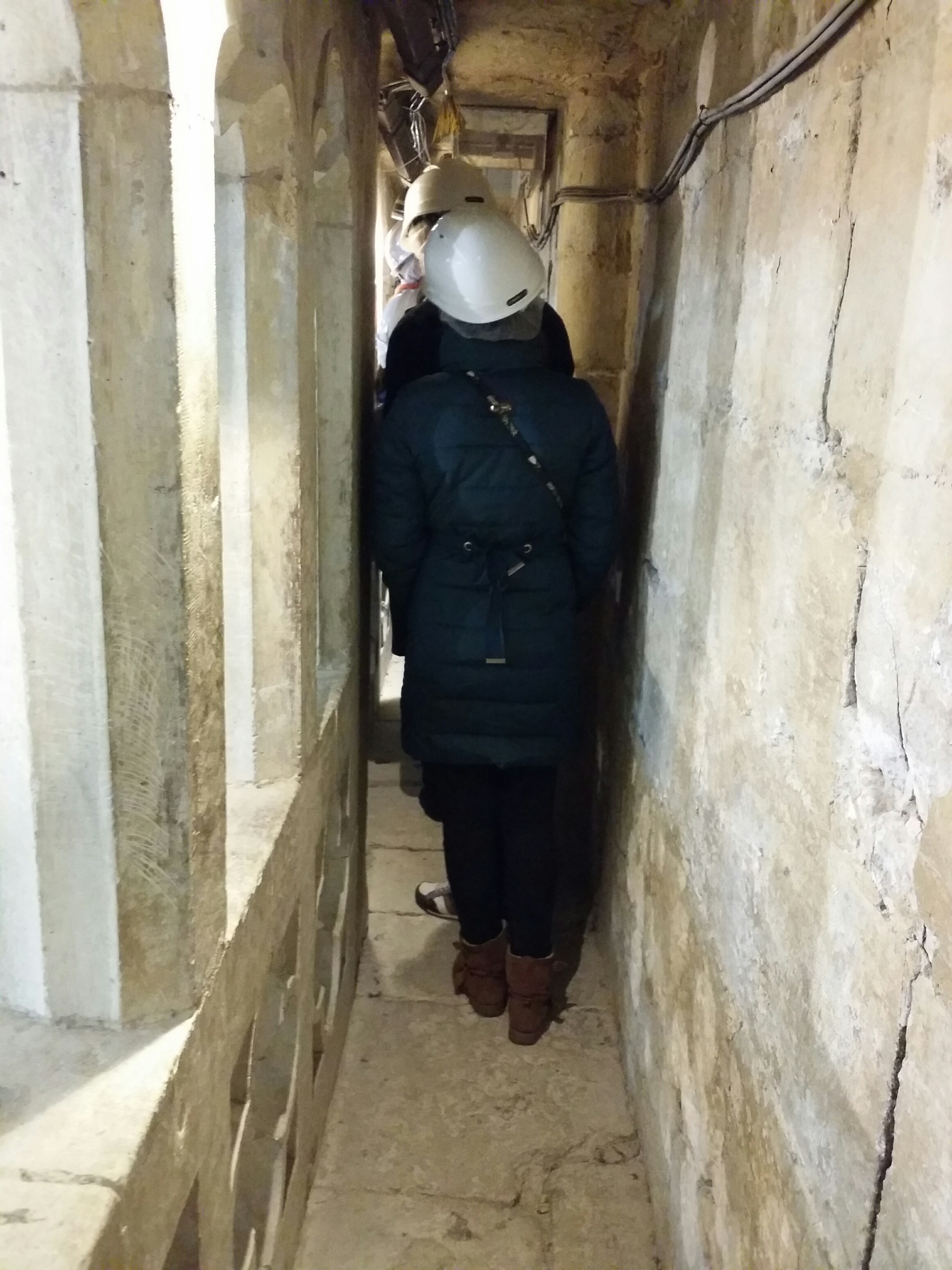
Passageway at the top of St. Mary’s Cathedral
VISIT TO THE CATHEDRAL
- Reservations: For organized group visits, we recommend calling +34 945 255 135 or sending an e-mail to visitas@catedralvitoria.com.
- Duration: 1 hour.
- Maximum group size: 15 people.
- Works: It may be the case that the visit cannot take place due to works.
- Beginning of the visit: Visitor’s Welcome Center with access from Plaza de la Burulleria or from Fray Zacarías Martinez Street.
- Virtual Tour: http://www.catedralvitoria.es/virtual/
- Minors: Although the price to be paid is null or symbolic, we must take into account that they occupy a place when counting the maximum number of people per group.
In order to better understand the importance of the Cathedral of Santa Maria de Vitoria-Gasteiz we can look at 5 different points, 5 points that will be explained to us perfectly during our guided tour.
4 points to learn more about the Cathedral of Santa Maria.
Location: This cathedral complex is located on the highest part of the promontory where the original city of Gasteiz was located, in an environment where the plains of Alava have a steep slope that is witnessed by the cathedral of Santa María.
Chapel of Santiago: This chapel built at the southern end of the complex in the mid-fourteenth century is later than the construction of the cathedral. A chapel composed of a single nave of two sections built outside the walls of the first walled enclosure that protected the city, taking advantage of each of the buildings that were located next to it.
Structure of the complex: This complex of historic buildings groups together a large number of buildings for different uses.
- – The church of Santa Maria, the oldest and main building of the complex.
- – The chapel of Santiago, today the parish church of Santa María.
- – The apsidal portico facing north-south.
- – The huge bell tower.
- – Service buildings of the Cathedral.

Stairs of the bell tower of Santa Maria Cathedral
Apart from the aforementioned buildings, during the 19th and 20th centuries administration, storage and other services related to the installation of the Episcopal see in Vitoria-Gasteiz were created.
Western portico and bell tower: This portico added during the 15th century and modified in the 16th century has great importance within the complex, an importance that is increased if we take into account the bell tower that rises above it, a tower dating from the 16th and 18th centuries that had to be rebuilt in the 19th century after a fire.

View from the top of Santa Maria Cathedral
Undoubtedly one of the most remarkable visits of all the Catholic temples that we can find throughout the Basque Country, a visit that we recommend to eyes closed.


0 Comments