





Table of Contents
Visit the interpretation center “Memorial del Cinturón de Hierro” and discover the ins and outs of one of the most exciting military buildings of the Civil War in the Basque Country, the Iron Belt.
This Interpretation Center keeps alive the spirit of the Iron Belt and the Basque people, who made a great effort to keep Franco’s army away from their urban centers.

Iron Belt Memorial Plaque
Before we talk about the Iron Belt Memorial, let’s unveil the answers to 6 essential questions about the Iron Belt:
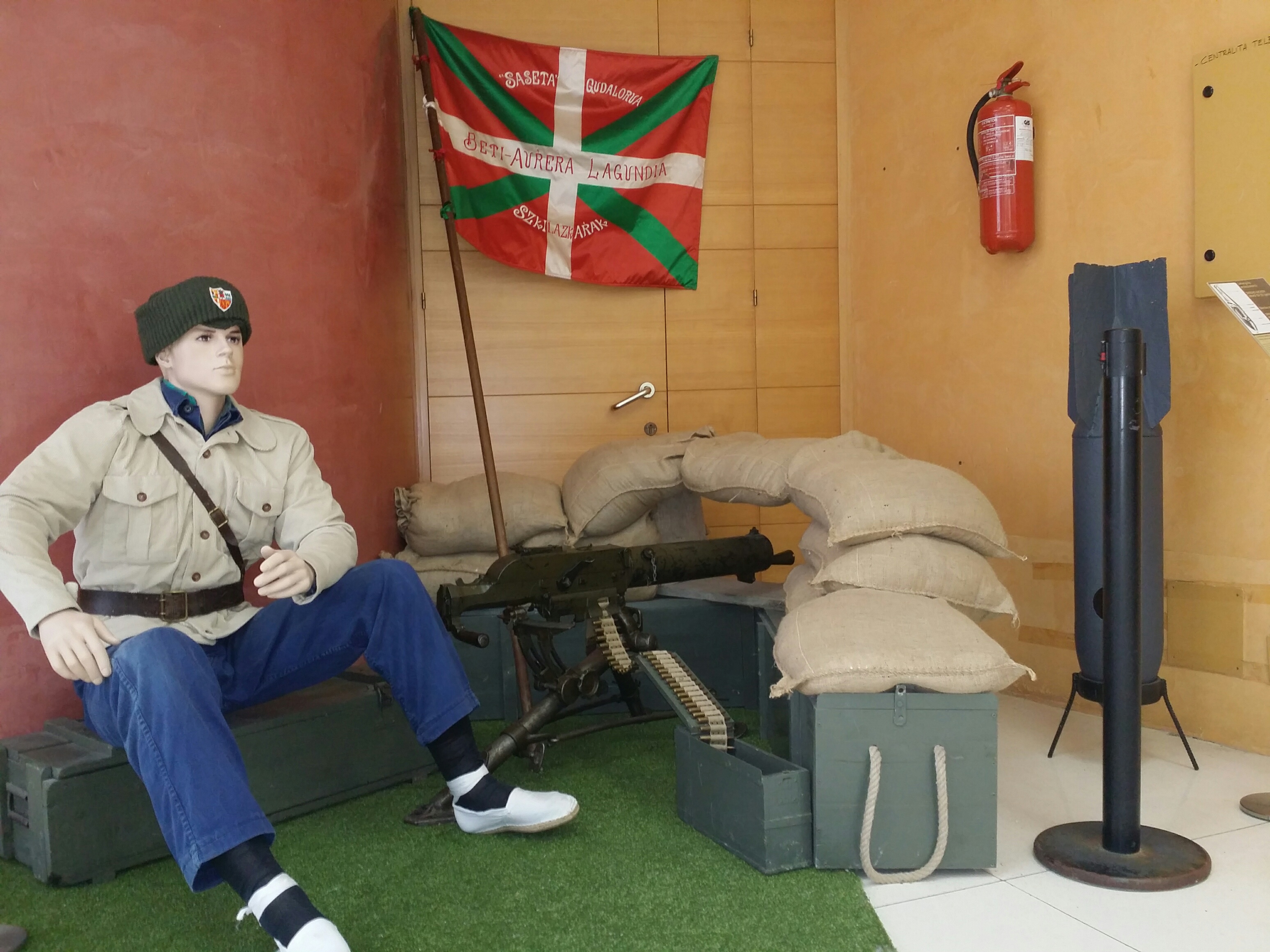
Reproduction Iron Belt
On September 22, 2012, coinciding with the 75th anniversary of the Civil War in the Basque Country, the City Council of Berango, with the collaboration of the Sancho de Beurko Association, inaugurated one of the few public spaces that highlights the value of this jewel of the Civil War in the Basque Country: The Iron Belt Memorial Interpretation Center.
This small museum represents a great legacy of the Basque people, a great heritage that unfortunately is not given the importance it deserves, Do you want to know the history of the Iron Belt? Be sure to read this article!!!
Iron Belt Timeline.
Beginning of the Iron Belt: The original name of this military building was Cinturon Defensivo de Bilbao. The name Iron Belt is the “commercial” name that the Francoists gave to this building in order to give greater importance to their victory.
The Iron Belt was built by 10,000 Basque men and women between 1936 and 1937 to defend themselves from General Franco’s aggressor army. This complex was formed by the mountains surrounding the city of Bilbao fortified by trenches, machine gun nests, barbed wire and many other defensive elements of the time.

Soldiers of the V Brigade of Navarra from their positions in the Urkulu. Photo EFE Agency
Fall of the Iron Belt: The two collaborators of Major Montaud, Captain Goicoechea and Captain Murga betrayed the government of Lehendakari Aguirre, providing detailed information about the Iron Belt to Franco’s army.
Thanks to the information provided by Captain Goicoechea, Franco’s army discovered the weaknesses of the Iron Belt. 3 areas where the construction was incomplete. These points were recognized and photographed by Franco’s airplanes providing more detail on their condition and location.

Photo of the Iron Belt. Photo Ojaguren
On June 12, 1937, taking advantage of one of these weak points, 110 airplanes, 200 cannons and 12,000 Francoist soldiers broke the Iron Belt leaving the city of Bilbao totally vulnerable.
Thus, the Basque army repulsed Franco’s attacks for 7 days until June 19, 1937, when the city of Bilbao fell into the hands of Franco’s army.
The Iron Belt from 1937 to the present day: After winning the Second World War, the United Nations isolated the Franco regime with the intention that it would decline. The regime sought sources from which to obtain the essential raw materials necessary for its industry, finding in the covers of the machine gun nests a great source of iron. In order to extract them, Franco’s army dynamited and exploited each of these machine gun nests. That is why today it is difficult to find them intact. The company awarded the contract for this work had as a majority partner Captain Goicoechea himself, a traitor, who made his actions profitable to a great extent.
Top 8 reasons why you should visit the Iron Belt Memorial.
Location: Located 10 minutes from the Berango metro station and about 15 minutes from the machine gun nests of the Berango and Sopela Iron Belt, the Iron Belt Memorial Interpretation Center is in a great location.
The Iron Belt Memorial is located in the cultural center of Berango, next to the church and the town hall of Berango, as you can see, you can’t miss it.
Historical memory: The Cinturón de Hierro Memorial Interpretation Center keeps alive the memory of all those who gave their lives in the Civil War in the Basque Country.

Reproduction Iron Belt
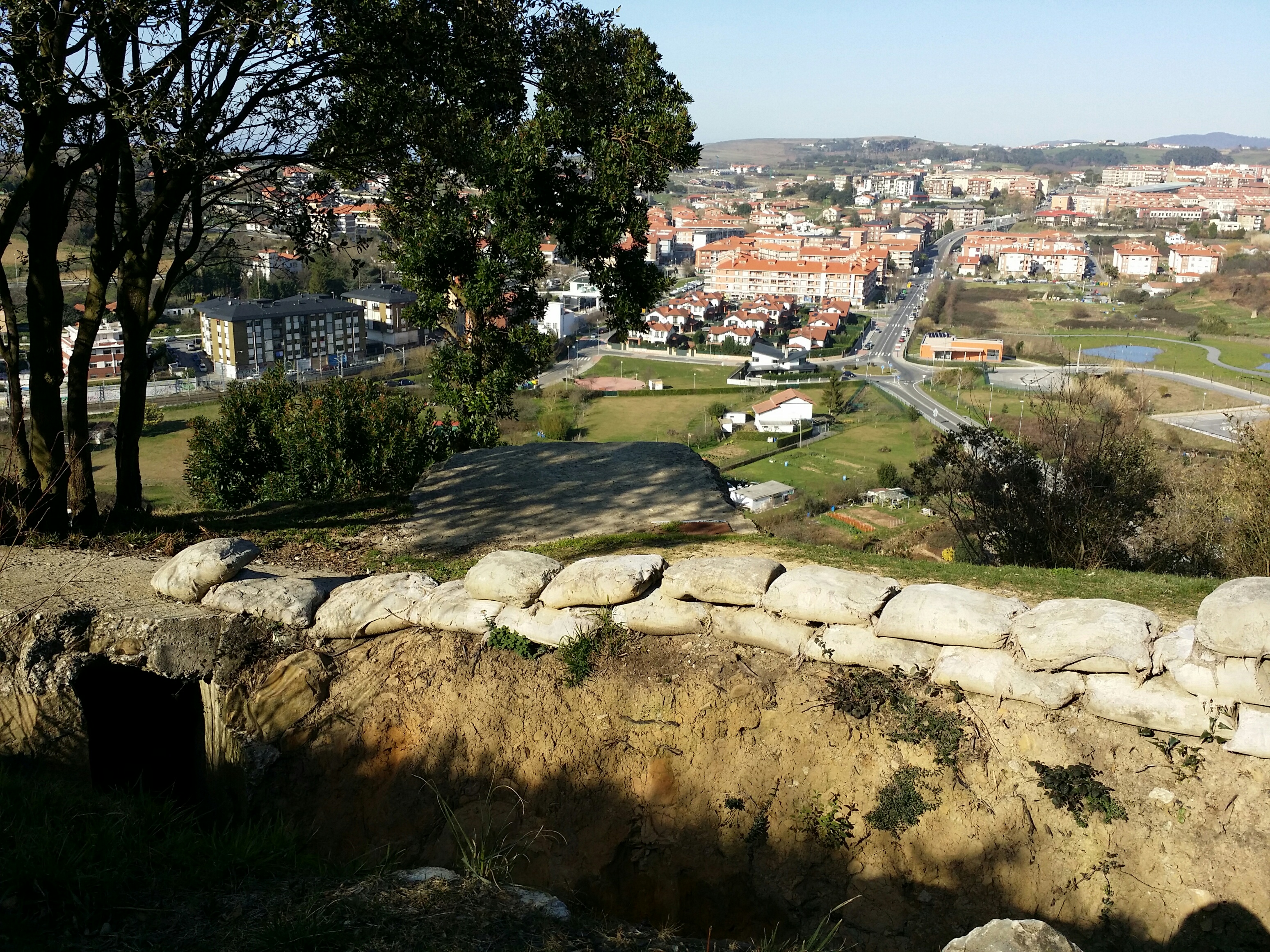
Guided Tour: During the guided tour we will have the opportunity to enjoy the Interpretation Center, watch a short film about the Iron Belt and visit the remains of the Iron Belt of Berango and Sopelana, a very complete visit of 4 hours. Remember that in order to make this visit we have to book in advance by calling the cultural center of the town hall of Berango, we leave you the contact telephone number in case you need it, Tel: 94 668 21 43.
627 420 860.

Iron Belt Memorial Guided Tour
Price: The high quality of the visit together with the fact that the visit is free of charge make the Iron Belt Memorial Interpretation Center the best value for money of all the places visited by TurismoVasco.com so far.

Accreditations: The Iron Belt Memorial Interpretation Center has obtained several accreditations throughout its short life. Witness to this are the Hemendik award from Deia and our exclusive “TurismoVasco Tiketa” accreditation.

Iron Belt Memorial Accreditations
Schedule: In winter from Monday to Friday from 12:00 to 14:00 in the morning and from 17:00 to 20:00 in the afternoon. In July the schedule is from 8:00 to 15:00. Remember, this is the center’s timetable. On weekends you can take the guided tour mentioned above.
Guide: Aitor Miñambres, responsible for tourism in the town of Berango and the interpretation center, takes us with his words in the middle of the Civil War, telling with great passion and detail the ins and outs of the Iron Belt, a luxury guide for a unique historical space.
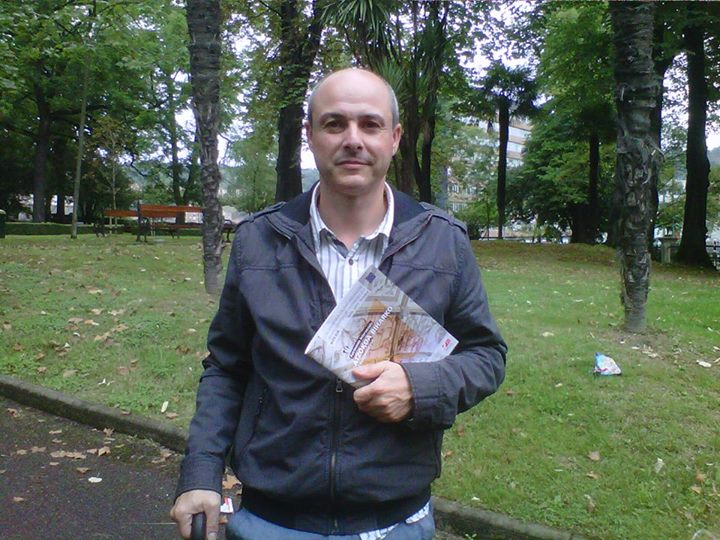
Aitor Miñambres
Symbol of the Civil War: The Iron Belt is, together with the town of Gernika, one of the most outstanding symbols of the Civil War in the Basque Country. We must remember that there are few war buildings that are preserved in the Basque Country, so we are facing a heritage that we must take care of and from which we have much to learn.
Curiosities of the Iron Belt Memorial.
-During the visit we will see guns manufactured by BH, Beistegui Hermanos S.A., the same brand that today produces high quality bicycles.
-The Iron Belt Memorial Interpretation Center has the most used bomb by the Condor Legion planes in the bombing of Bizkaia.

Most used bombs by the Condor Legion aircraft
-During the guided tour you will visit the Areneburu machine gun nest, the best preserved machine gun nest in the entire iron belt.

Areneburu machine gun nest
-A museum where feelings meet: The Iron Belt Memorial not only displays war objects. Among its collection are personal objects of Basque combatants and of many of the people who collaborated in the creation of the Iron Belt.

Memorial items Iron belt
-TheSancho de Beurko Association: Owner of most of the elements exhibited in the Iron Belt Interpretation Center, it owes its name to a man who lived from the inside the Civil War in the Basque Country, Luis Ruiz de Aguirre y Urquijo, literary known as “Sancho de Beurko”, General Commissar of the Basque Army.

Sancho de Beurko Association
In 1999, at the wish of Sancho de Beurko himself, the association that bears his name began to study the fronts that the Basque Army defended in 1936 and 1937, rescuing this valuable heritage from its continuous deterioration.
Undoubtedly the Iron Belt Memorial is a must visit to know part of our past, part of our history. We leave you with this video about the Iron Belt, do not forget to take the guided tour of the Iron Belt Memorial!!!


0 Comments